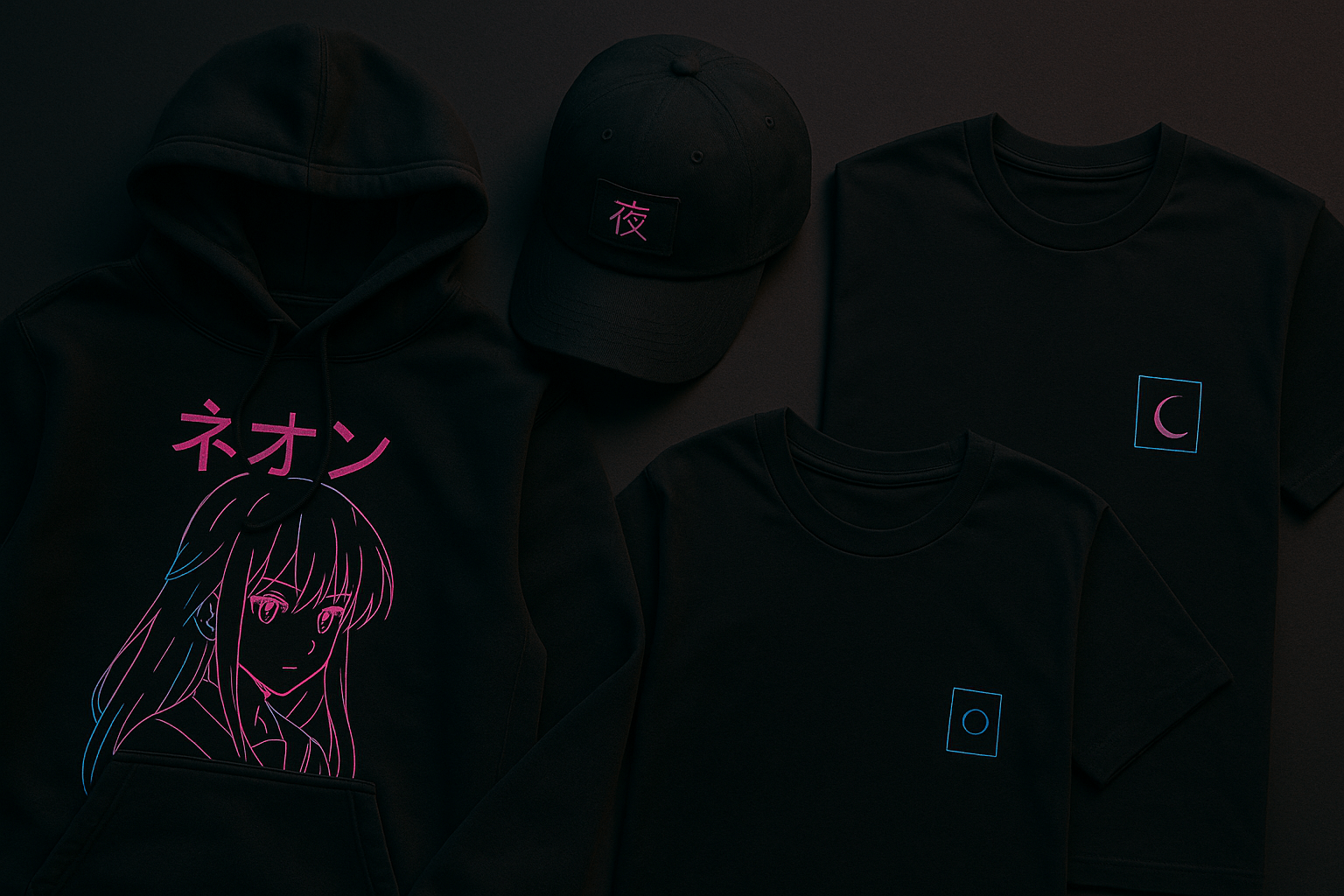
There are two kinds of anime clothing: clothing you wear because it signals you watch anime, and clothing that happens to reference anime and also works as clothing. The first kind has a ceiling. The second kind has no ceiling at all — it's just good design that comes from a specific cultural context.
The difference isn't about quality, necessarily. It's about what the piece is designed to communicate and to whom.
The Tourist Problem
A large graphic of a character's face on a white tee is tourist merch. It's designed to signal "I know this thing" to other people who know the thing. It works very well for that purpose. It's also very hard to integrate into a wardrobe that's doing anything else.
This isn't a judgment about wearing it — wear what you want. But if your goal is clothing that functions both as fan expression and as actual wearable pieces with visual coherence, full-face character graphics on a white tee are working against you in most contexts outside of conventions.
What Works Instead
The pieces that age well tend to be the ones that take a visual element from the source material and treat it as design material rather than promotional material. Akatsuki cloud pattern on a quality hoodie. A specific color palette from a series rendered in all-over print. Typography from a show's logo as text on a clean background. The kanji from a character's name as a single element on a solid garment.
These work because they communicate to people who know, without requiring that the piece explain itself to people who don't. A piece of clothing that needs context to read as intentional is a weaker piece than one that reads as intentional regardless.
Fabric and Construction
The easiest way to separate credible anime clothing from convenience merchandise is fabric weight and construction. Mass-market character tees tend to use 140–160 gsm cotton with direct-to-garment printing that fades quickly. Anything that's going to hold up and feel intentional in your wardrobe is typically 240 gsm or heavier, with embroidery or screen-printed graphics rather than DTG for the key design elements.
For hoodies: the difference between a 280 gsm and a 400 gsm hoodie is immediately apparent in hand. The heavier garment drapes differently, holds shape differently, and communicates differently. This isn't snobbery — it's just how textiles work.
Where to Actually Look
For independently designed pieces that take the design quality seriously, look for smaller labels built around specific series rather than general "anime merch" stores. Labels that operate around drop culture — releasing limited quantities tied to specific moments in a series — tend to put more thought into design because they have a smaller, more attentive audience.
Japanese brands that have been operating in this space since before anime became globally mainstream tend to have stronger quality controls and more sophisticated design references. The gap between what's available domestically in Japan and what gets exported has narrowed significantly in the past five years, but the domestic market still rewards quality in ways the global licensing market doesn't always match.
The One Rule
If you'd wear the piece if all the anime references were removed, it's probably a good piece. If the anime reference is the only reason the piece makes visual sense, it's serving a different purpose — which is fine, but worth knowing going in.