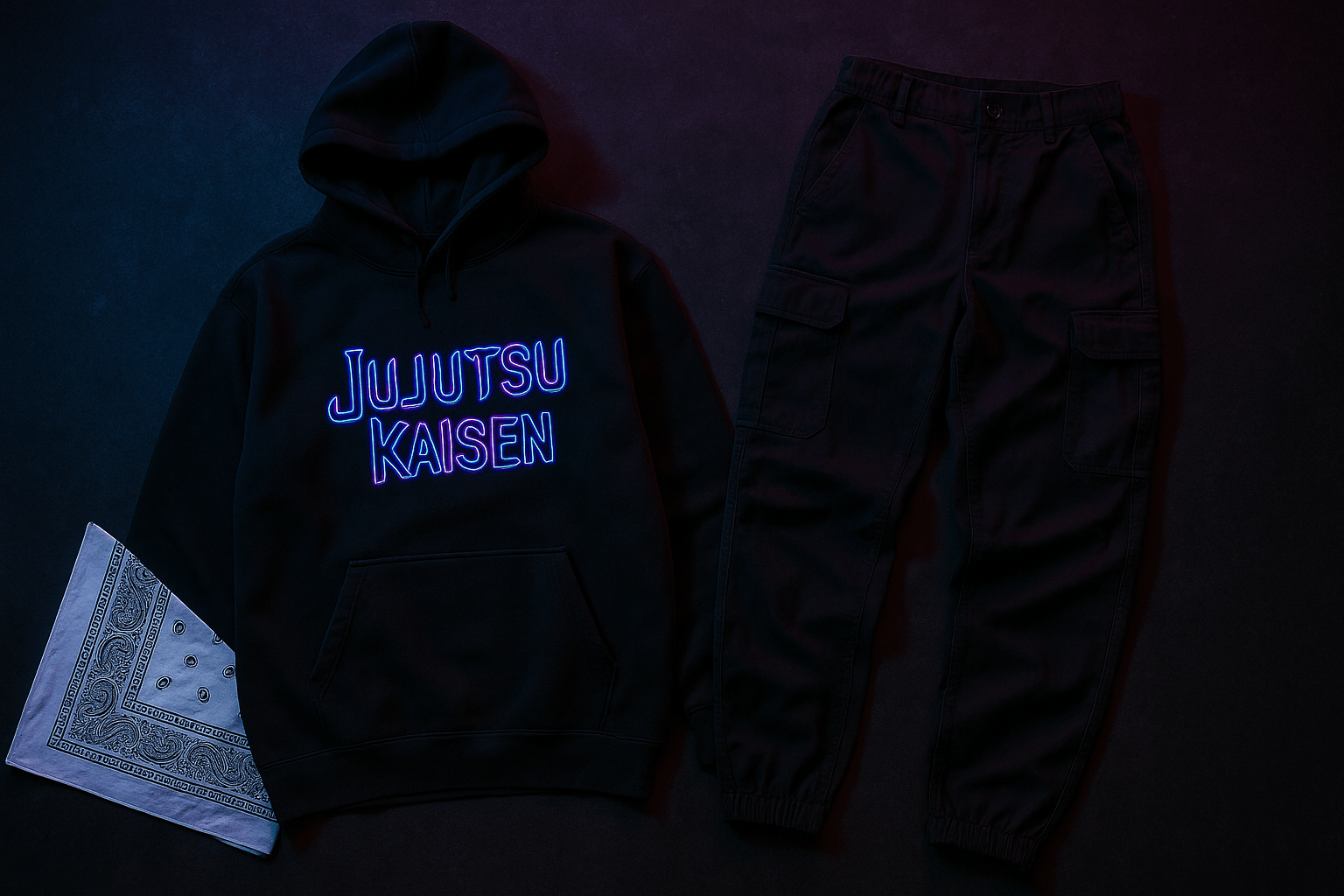
Before the Official Drop
Gege Akutami's manga ran from 2018. The anime adaptation hit in October 2020. By late 2021, before Crunchyroll or Shueisha had put out much beyond basic logo tees, you were seeing Gojo's black blindfold rendered on hoodies, bucket hats, and custom embroidered pieces on every resale platform.
That's not normal. Most anime series have a gap between cultural penetration and merch saturation — the official product follows the wave. JJK's fashion references started circulating almost simultaneously with the show itself. Something about its visual language made people want to wear it immediately, without waiting for a licensed version.
Gojo as a Brand Identity
Every iconic piece of character design does the same job: it gives you immediate visual shorthand for who this person is. Naruto's orange jumpsuit says "look at me." Levi's undercut says "efficient, serious." Gojo's blindfold says something different — it says confidence without needing to show off. He could see you clearly even when you can't see his eyes. That's a particular kind of arrogance that translates really well into fashion.
The all-black uniform with minimal detailing is worth paying attention to separately. It's clean. It's not trying to be anything except functional. And then there's the blindfold — the one loud statement that makes the whole fit. That contrast is exactly how some of the best streetwear pieces work: mostly quiet, one thing that commands attention.
"The blindfold wasn't about hiding his eyes. It was about controlling what people focus on. That's styling."
The Uniform as Baseline
Jujutsu High's uniform does something smart: it gives a legible group identity while letting individual characters deviate from it. Yuji wears it straight. Megumi wears it with slightly different energy. Nobara styles it differently again. The uniform is the canvas, not the statement.
This is how school uniforms function in Japan in general, and anime has always reflected that reality. But JJK pushes it further because the non-uniform characters — Gojo, Nanami, Mei Mei — dress in ways that signal their position relative to the institution. Nanami's suit and tie is specifically not trying to be cool, and somehow that makes it very cool.
Nanami: The Real Style Reference
If you were paying attention, the character who actually had the most influential wardrobe wasn't Gojo. It was Nanami Kento. The three-piece suit. The pocket square. The stripes. The reading glasses. Nanami dresses like someone who has thought carefully about clothes and decided to dress well without making it a personality.
In a genre where characters typically signal their strength through dramatic or flashy designs, Nanami's restraint is the statement. He's dressed like a professional who would also win in a fight. That specific combination — grounded adult wardrobe, completely competent in combat — created a character archetype that people who weren't interested in anime at all started finding interesting.
What JJK Actually Changed
Before JJK, the anime-to-streetwear pipeline ran through nostalgia. Naruto, DBZ, Bleach — you wore them because you grew up with them. The aesthetic was secondary to the emotional attachment.
JJK worked differently. People engaged with the fashion references before they had years of attachment to the series. The visual design was good enough to stand alone. That shifted how a certain subset of people thought about anime merch — not just as fan merchandise, but as actual design objects worth engaging with on aesthetic grounds.
That shift has continued. Series that follow JJK in terms of visual ambition — Chainsaw Man, Spy x Family, Oshi no Ko — are also generating style conversation faster and earlier than the older model. Something about the expectation has changed.