The Haori System
A haori is a hip- or thigh-length jacket worn open over a kimono. In Demon Slayer, every Hashira has one. And each one is completely different — pattern, color, weight, the degree to which it suggests personality. This is the show's visual system in one garment.
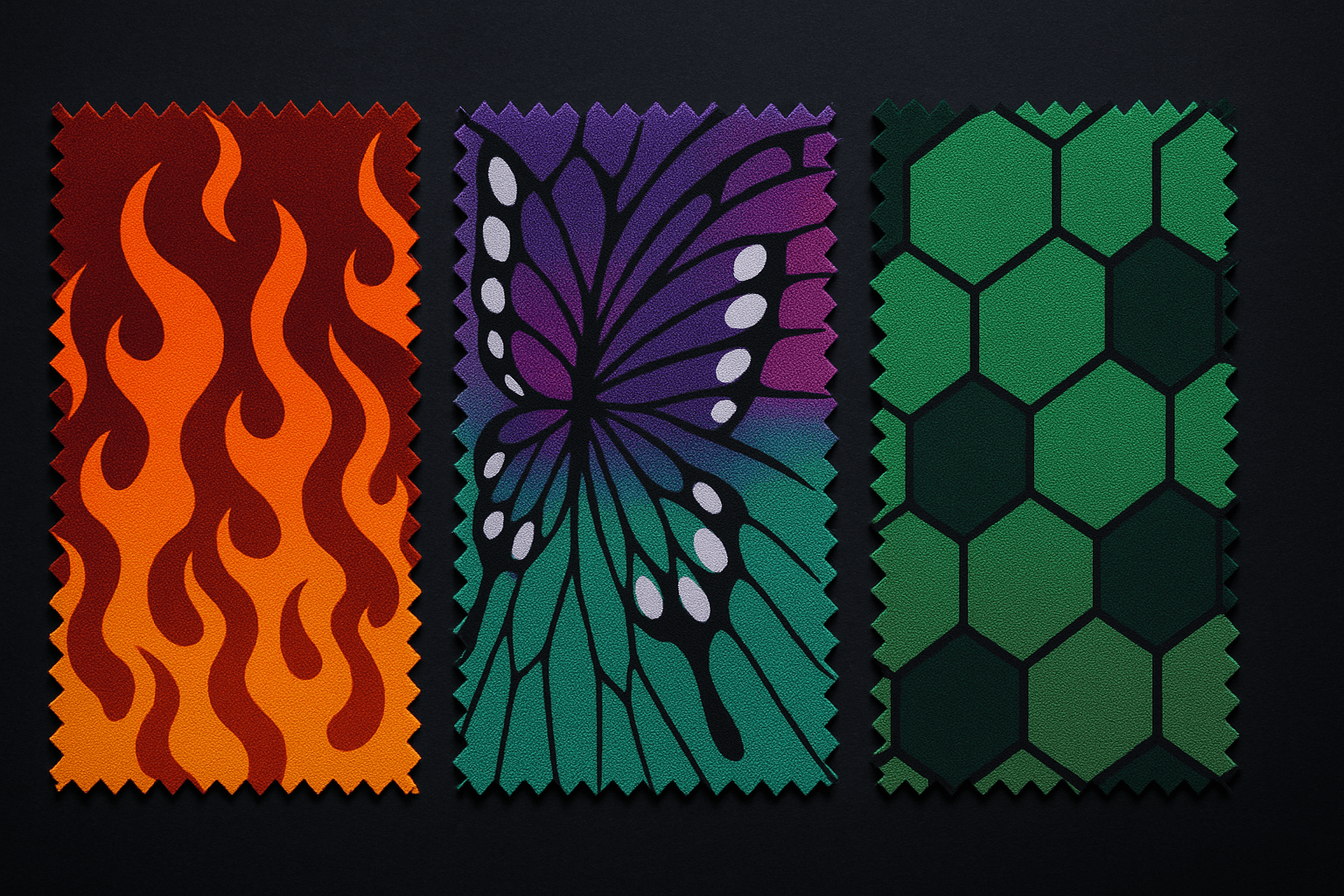
Rengoku's flame pattern. Shinobu's butterfly gradient from dark to lilac. Tengen's flashy geometric print in gold and white. Gyomei's plain brown. Mitsuri's pink-and-green gradient that fades differently depending on the scene's lighting. Each haori works as a character summary. You could probably guess a significant amount about a character's personality from their haori alone, without ever seeing them fight.
How Fashion Does the Same Thing
This isn't an accident, and it's not unique to anime. Fashion houses do this deliberately. A collection is supposed to have a point of view — a color story, a recurring silhouette, a unifying element that lets each individual piece be different while belonging to the same family.
What ufotable did with the Hashira is essentially a fashion collection brief translated into character design. Each Hashira is a look. The haori is the hero piece. The underlying uniform is the baseline that makes the differences readable. Without the shared elements, the contrast wouldn't land as hard.
Tanjiro Is Deliberately Understated
The protagonist's design does something interesting: it's quieter than almost everyone around him. The green-and-black checkered haori is striking in pattern but restrained in palette. Compared to the Hashira, Tanjiro's fit reads almost plain.
That's intentional. The protagonist is supposed to be the constant you read everyone else against. If Tanjiro's design was as loud as Rengoku's, you'd lose the contrast that makes the Hashira feel exceptional. His understated palette is doing work.
Taisho Period Japan as Source Material
The series is set during the Taisho period (1912–1926), a moment when Japan was absorbing Western influence while simultaneously intensifying interest in traditional crafts and textiles. The result was a specific kind of maximalism: intricate Japanese patterns worn in combinations that would have previously seemed excessive.
That visual richness is exactly what ufotable brought into the animation. The pattern-on-pattern, the heavy textile feeling, the way light interacts with printed fabric in the show — it's based on real historical aesthetics. The show is drawing from an actual design tradition, which is part of why it looks so grounded even when the fights are completely fantastical.
What Designers Are Taking From This
Since Demon Slayer's cultural peak in 2020–2021, there's been a noticeable uptick in anime-inspired print work in streetwear and even higher-end fashion. Some of it is explicit reference. More of it is the underlying logic: bold geometric or organic pattern on a specific garment, restrained palette elsewhere, one loud element that reads clearly at distance.
The haori's function as a statement layer over a uniform is also interesting structurally. It maps almost directly onto how contemporary wardrobe layering works: base layer, core layer, one outerwear piece that carries all the personality. That's not a Japanese tradition specifically — it's just good garment thinking, and Demon Slayer happens to visualize it really clearly.